When people look up what AI agents can do in sales, they usually find lists of tools: a meeting recorder here, an email generator there, a website chatbot somewhere else. We look at it differently, because we run sales on an agentic system in our own company. This article describes which sales work an agent can take over, what always stays with a person, and what has to sit in between so a salesperson can trust the agent.
The short answer
AI agents in sales take over the preparation and the writing: they gather what the company knows about a client before a meeting, draft the follow-up and the proposal after it, work out who to contact today, and record meeting decisions and action items in the client's record. The conversation with the client, the price, commitments and sending stay with a person. Between the agent's draft and the message to the client sit gates that enforce the company's rules.
The last sentence matters most. An agent that writes well nine times out of ten and, the tenth time, sends a client a promise outside the offer on its own does more harm than good. That is why in sales the agent prepares and a person decides.
What an AI agent does in sales
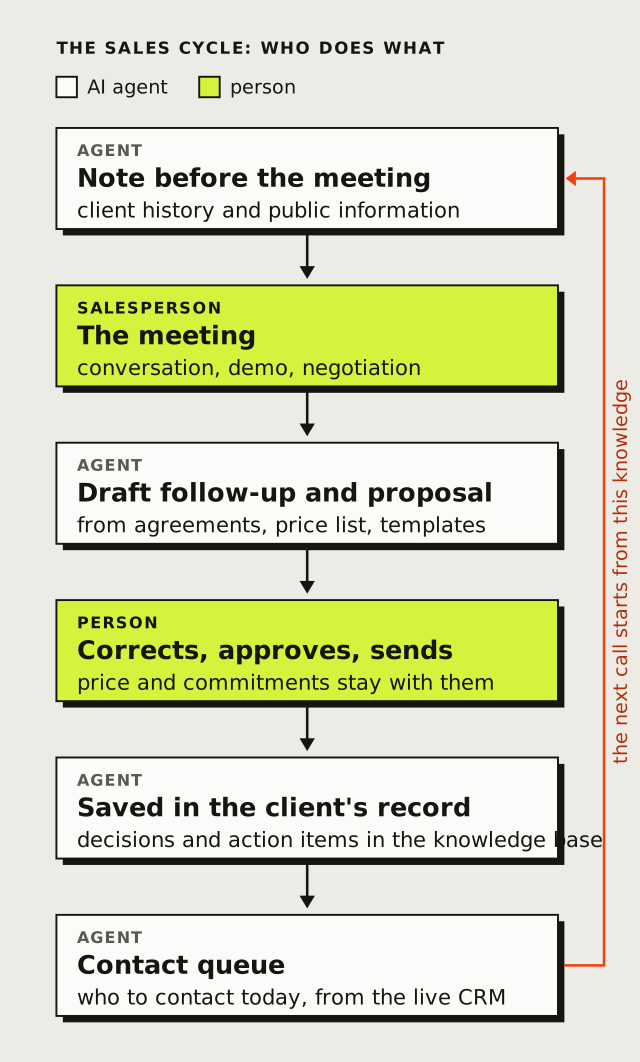
Below are four kinds of work agents do for us. They prepare materials for review and organise client knowledge, and messages and proposals remain drafts for a person to approve. None of this work ends with a message sent to a client.
Preparing for a client meeting
You give the company name and the person's name. The agent checks what the company already knows about this client: earlier agreements, notes, proposals sent and open matters. Then it adds public information, for example from the company's website and public registers, and writes a short note: who you are talking to, what you agreed before, what is open and what is worth asking. Whatever it could not establish, it says so plainly instead of guessing.
For us, preparing for a meeting takes about an hour. The agent gathers information about the company, the person, the problem, the possible use and the risks, and we read it, ask follow-up questions and prepare materials. The details of the process are on the page AI agent: preparing for a client meeting.
The follow-up and the proposal after a meeting
After the call you hand the agent your notes, a transcript or a few sentences recorded by voice. The agent pulls out the agreements and tasks, records them in the client's record, drafts the follow-up and, when needed, a proposal from the price list, the service descriptions and earlier proposals. It does not invent a price the list does not have: it flags it for you to fill in. What both drafts are built from is shown on the page AI agent for proposals and follow-ups.
Today's contact queue
On a sending day, the agent reads the mailbox and the CRM, matches replies to companies and works out what comes next with whom. It builds today's queue from the current state of the CRM, not from yesterday's file, because the file does not know what went out yesterday. With us, the message text is written by a separate agent that does not see the CRM and only gets a brief. That way it writes from what it has to say, not from the whole history, which could distract it.
Keeping client knowledge in order
Every note before a meeting and every agreement after it stays in the knowledge base with the client. Before the next call the agent starts from what it already knows, and when someone else on the team takes over a client, they do not have to rebuild the history from mailboxes and memory. Our company and contact data live in a CRM in Airtable, and the system keeps a copy next to the rest of the sales team's knowledge: how we run conversations, playbooks and message templates. How to set up such a base is covered in the article a company knowledge base for AI agents.
What stays with a person
An agent in sales does not replace a salesperson. It takes away the work that is neither a conversation with a client nor a decision. These always stay with a person:
- the conversation with the client: the meeting, the demo, the negotiation,
- price and terms: the person responsible for them approves scope and price in a proposal,
- commitments: the agent promises nothing on behalf of the company,
- sending: a person reads, corrects and sends every message and proposal.
| Work | AI agent | Person |
|---|---|---|
| Before the meeting | gathers knowledge about the client and writes a note with questions | reads, asks follow-up questions, prepares materials |
| The meeting | — | runs the conversation |
| After the meeting | pulls out agreements, drafts the follow-up and the proposal | corrects, approves the price, sends |
| Next contacts | builds the queue from the CRM, proposes messages | approves the summary and sends |
| Client knowledge | records decisions and notes in the client's record | corrects what the agent got wrong |
Gates: what sits between the draft and the client
"A person approves" is not enough when an agent prepares a dozen or more messages a day. Someone reviewing a long summary eventually stops reading carefully. That is why gates do part of the checking: rules every proposal has to pass before it even reaches a person.
With us, almost 40 gates sit between an agent's proposal and a draft in the mailbox. They make sure, for example, that:
- one person has one active thread,
- the daily email limit and the limit of three contact attempts per person are not exceeded,
- nobody who has declined gets another message,
- a message promises nothing outside what we offer.
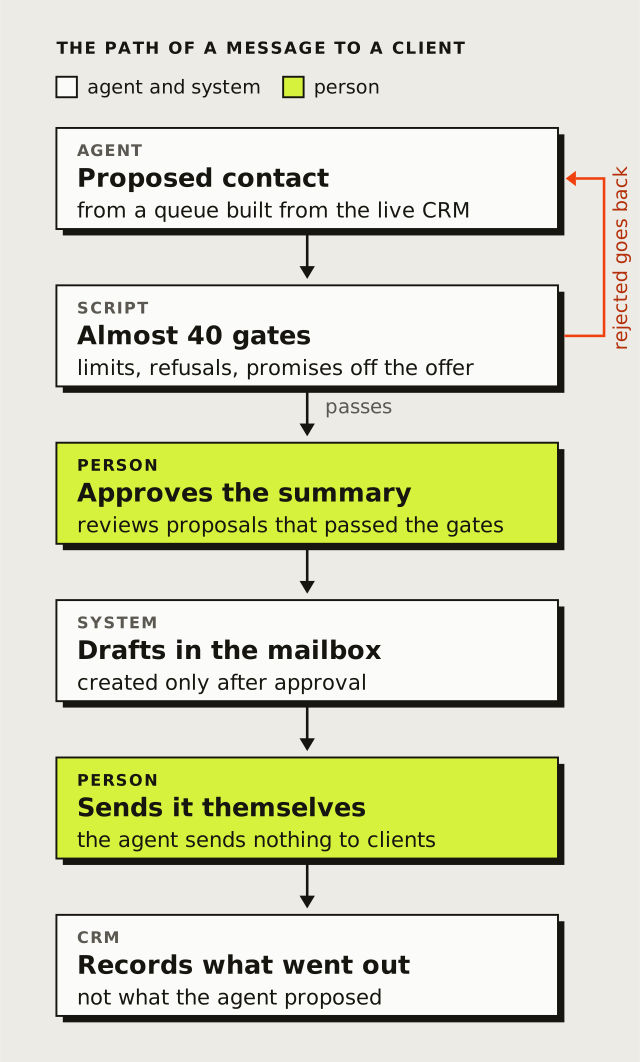
Whatever a script can check, a script checks: it is cheaper than a model and gives the same result every time. The model is left with the writing and with judging what a script cannot measure. Only after the summary is approved do drafts appear in the salesperson's mailbox, and the CRM records what actually went out, not what the agent proposed.
How an AI agent differs from sales automation
An email sequence in an automation tool sends prewritten messages on a schedule. An AI agent writes each message from what the company knows about the specific client, and decides whether it is worth getting in touch today at all. That flexibility has a price: an agent can get things wrong in ways a template cannot, which is why it needs gates and a person before sending. The difference between an agent, a chatbot and automation is covered in more depth in what an agentic system is.
What did not work at first
The quality of the messages our agent wrote was not good enough at first, and most of the corrections went into the writing. We recorded corrections that kept coming back as rules or gates, so the same mistake would not return. We work the same way in the first weeks of a deployment, and one of the quality measures then is the share of drafts approved without corrections. We write more about that period in how an AI agent implementation works, and show our whole sales team from the inside in how we run our company on an agentic system.
When AI agents in sales make sense
- You have several client meetings a week and before each one you search for what you agreed last time.
- After a meeting someone writes a follow-up, and a proposal in the evening, often by copying the last one.
- Knowledge about clients sits in the heads, mailboxes and notes of several people.
- You have a price list, service descriptions and a few proposals already sent, or they can be gathered.
It makes less sense when sales means a few conversations a month, or when every proposal is written from scratch and cannot rest on a price list or templates. Then it is worth checking first whether the chosen process has enough repeatable steps to justify a deployment.
Where to start
With one process. Most often it is preparing for meetings or proposals and follow-ups, because we have a ready set of processes for sales. A deployment covers system configuration, documentation and team training, and costs from PLN 9,000 net. On the company's side there is a Claude Team subscription for every person who works in the system. What the price is made of is laid out in how much an AI agent implementation costs, and the whole system is described on the agentic system for companies page.
Frequently asked questions
What can AI agents do in sales?
Prepare notes before meetings, draft follow-ups and proposals after meetings, work out who to contact on a given day, and record meeting decisions and action items in the client's record. The agent prepares materials for a person to review and keeps client knowledge organised, and messages and proposals remain drafts for approval.
Will an AI agent replace a salesperson?
No. The agent takes over the preparation and the writing. The conversation with the client, the price, commitments and the decision to send stay with a person.
Does an AI agent send emails to clients by itself?
No. The agent prepares a draft, gates check it against the company's rules, and a person reads, corrects and sends it. A person approves every step that cannot be undone.
Does an AI agent work with our CRM?
It can. To start, notes and company files are enough. We add integrations with a CRM, mailbox or calendar when the process really needs them, and quote them separately.
How much does deploying AI agents in sales cost?
From PLN 9,000 net for the first process, depending on scope. Further processes and integrations are quoted separately.
Summary
AI agents in sales do what salespeople usually dislike: digging up a client's history, writing follow-ups and proposals, keeping track of who to contact. The conversation, the price and sending stay with a person. Gates help catch breaches of the company's rules before a draft reaches them, and the person still reviews and approves every message before it is sent.
Want to check which sales process to hand to agents in your company? Book a meeting at a time that suits you. It takes about an hour and ends with choosing the first process. Prefer to write first? hello@200iqlabs.io.