Companies that ask us about AI agents rarely start with the technology. They ask what it will look like for them: how much of the team's time it takes, who does what, what they get at the end, and what happens when an agent gets something wrong. This article describes implementing AI agents in a company from your company's perspective: from the first meeting, through configuration and training, to the first weeks of work and further cooperation.
The short answer
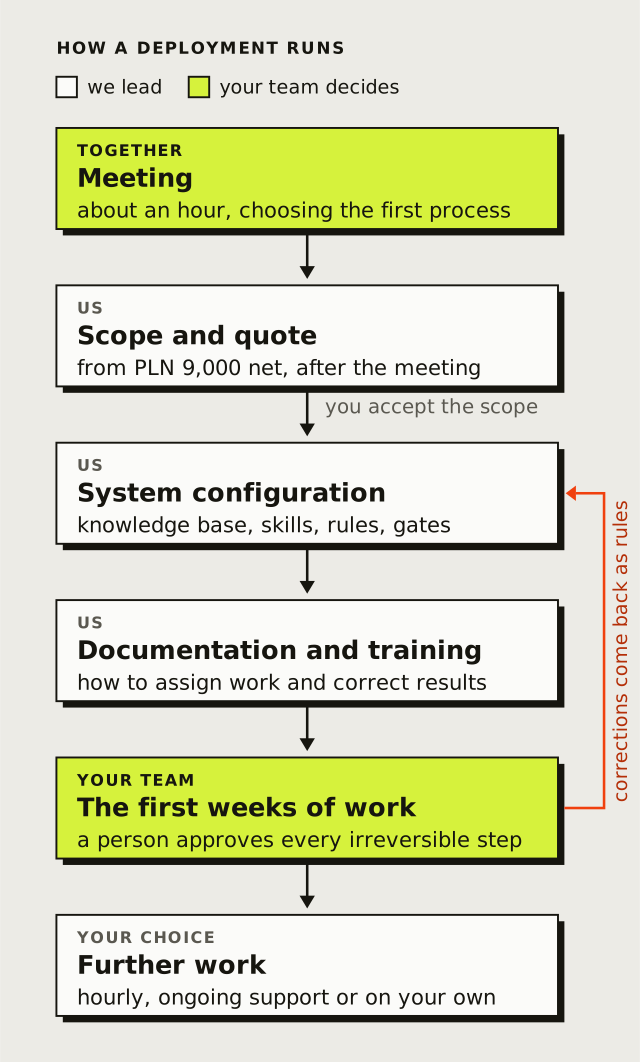
Implementing AI agents in a company has three stages with us. The meeting takes about an hour and ends with choosing the first process. The rollout is configuring the system in the company, documentation and team training, and the price starts at PLN 9,000 net. Further work is billed hourly or as ongoing support, and you can also develop the system on your own.
The biggest change, though, happens not during the rollout itself but in the first weeks of work. That is when the team starts correcting the agents' results, and every correction that repeats becomes a rule. Whether that loop works decides whether the system fits the company better over time.
Before the meeting: what to prepare
Nothing is required. The meeting works without any materials, but it goes faster when you have at hand:
- a list of repetitive work that takes your or your salespeople's time every week: notes before meetings, proposals, follow-ups, reports,
- examples: two or three proposals or emails you are happy with, and one you are not,
- where the knowledge lives today: the CRM, the inbox, the drive, notes, someone's head,
- the name of the person who would develop the system on the company's side, if there is one.
The knowledge does not have to be organized. Organizing it is part of the rollout.
Stage 1: the meeting
The meeting takes about an hour, and it works best when the people who do the process take part, not only those who decide about it. We go through the company's processes and look for the place where people lose the most time on work that is neither a conversation with a client nor a decision.
The meeting ends with choosing the first process. A good first process:
- repeats every week,
- takes the time of the person whose time is most expensive,
- has a result that is easy to judge: the proposal is good or it needs fixing.
In service companies it is most often preparing for a client meeting or proposals and follow-ups, because we have a ready set for sales. At the meeting we also settle which layers of the system are needed: whether the knowledge the company already has is enough, or whether the CRM, inbox or calendar need connecting.
We prepare the quote after the meeting, once we know the scope. A rollout starts at PLN 9,000 net, and what the price is made of is broken down in how much an AI agent implementation costs.
Stage 2: the rollout
Once you accept the scope, we start the configuration. Most of the work is on our side, but it cannot be done without your team, because your team knows the company.
| Part of the rollout | What we do | What your team does |
|---|---|---|
| Workstations | we set up the Claude app and the company's shared folder | creates Claude Team accounts, one per person |
| Knowledge base | we gather the knowledge the first process needs and lay it out in files | provides materials and answers questions about what is not written down |
| Skills | we describe the process step by step: where the agent gets data, what it checks, what the result looks like | says how the process really works, not how it works in theory |
| Rules and gates | we write down what the company never does and put gates before every step that cannot be undone | decides who approves the result at each gate |
| Integrations | we connect tools through official Claude connectors on the company account, if the process needs them; integrations are quoted separately once the needs are clear | grants access to the tools |
| Documentation and training | we write the documentation and train the team | learns to assign work to agents and correct their results |
Workstations and the knowledge base
Everyone works on their own computer, macOS or Windows, using the Claude app and the company's shared folder. There is no new panel to log into. That folder is where the knowledge base grows: the description of services, the price list, templates, what was agreed with clients, the state of work. We lay it out so that an agent reads only what it needs for the task. How we do it is described in a company knowledge base for AI agents.
Skills, rules and gates
We write the process down as a skill, an instruction the agent loads when it does that process. Rules and gates come on top. The most important gate is always the same: nothing goes out to a client without a person. The agent prepares a draft, and a person approves and sends it. Whatever can be checked by a script is checked by a script, because it costs less than the model and gives the same result every time.
Documentation and training
Training covers two things. The first is working in the system: how to assign tasks to agents, by voice too, and how to read their results. The second is working on the system: how to correct a result so the correction is saved as a rule and the mistake does not recur. That second skill decides whether in two months the system is better than on the day it was rolled out.
The first weeks: corrections become rules
An agent's first results are rarely what the company wants straight away. Ours were not either. When we built our own system, the quality of the messages the agent wrote was not good enough at first, and most corrections went into the writing. Every correction that repeated became a rule or a gate, so the same mistake stopped coming back. What that system looks like today is shown in how we run our own company on an agentic system.
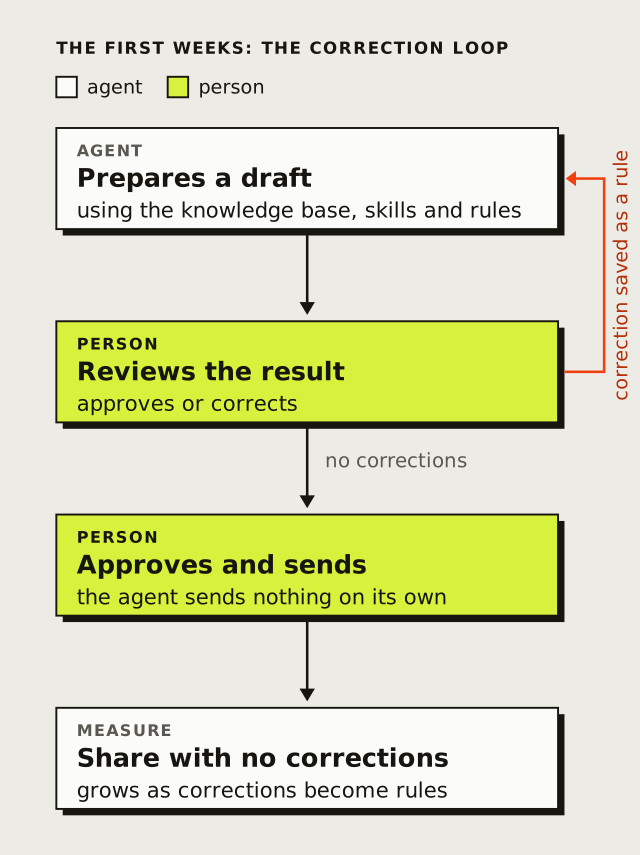
That is why in the first weeks we measure one number: what share of the agent's proposals a person approves without corrections. It grows when corrections become rules. It stands still when people correct quietly and write nothing down. This is a way of measuring, not a promise of a result, because in every company that number starts from a different place.
Stage 3: further work
The whole team uses the system, but someone has to develop it: add rules, add further processes, look after quality. That person needs dedicated time for it. After the rollout you have three options:
- you develop the system yourself, and the rollout was a starting point, not a permanent dependency on us,
- hourly billing for specific work, such as adding another process or integration,
- ongoing support, meaning monthly support within an agreed scope.
We settle the model after the first meeting, once it is clear how much development the system will need. Further processes and integrations are quoted separately. Each additional process is easier than the first, because the knowledge base and rules already exist.
What decides whether the rollout works
In our experience the result depends on the organization, not the model:
- One process to start. Five processes rolled out halfway give less than one rolled out completely.
- A person with time to develop the system. A system without an owner stops matching how the company works within a few weeks.
- Corrections written down, not just made. If a correction is not saved as a rule, the same mistake recurs next week.
- A person at every step that cannot be undone. One automated mistake sent to a client is enough for the team to stop trusting the system.
More on what the system itself is made of is in what an agentic system is, and on what changes in the team's work in implementing Claude in your company.
Frequently asked questions
How does implementing AI agents in a company work?
It starts with a meeting that takes about an hour and ends with choosing the first process. Then we configure the system in the company, write the documentation and train the team. In the first weeks the team works in the system and corrections become rules. Further work is billed hourly or as ongoing support.
How much of my team's time does the rollout take?
Most of the team's time goes into the meeting, handing over knowledge about the process, and training. We do the rest of the configuration. After the rollout, time is needed mainly by the person who develops the system; that part can also be handed to us.
Do I need a new tool or panel?
No. The system runs on Claude and the company's files. On the company's side there is a Claude Team subscription for every person who works in the system.
Will an agent send something to a client without our approval?
No. The agent prepares a draft, and a person approves and sends it. A person approves every step that cannot be undone.
How much does implementing AI agents cost?
From PLN 9,000 net, depending on the scope. Further processes and integrations are quoted separately. Details are on the agentic system page.
Summary
Implementing AI agents has three stages: a meeting where we choose the first process, a rollout with configuration, documentation and training, and further work in the model you choose. The most important part, though, happens in the first weeks, when the team's corrections become rules and the system starts working the way your company works.
Want to find out which process to start with? Book a meeting at a time that suits you. It takes about an hour and ends with choosing the first process. Prefer to write first? hello@200iqlabs.io.