Before we started rolling out agentic systems for other companies, we built one for ourselves. We are a two-person company: we sell 200IQ LABS services and develop our own product, Qamera AI. Sales, publishing and the monthly finance close all run on our agentic system. This post shows what that looks like from the inside, including what broke and how we fixed it.
Sales: the sending day, meeting prep, messages after a call
Przemek runs sales for Qamera AI, and the system takes the prep work off his plate. Company and contact data lives in our Airtable CRM, and the system keeps a copy of it alongside the rest of the department's knowledge: the conversation doctrine, playbooks, message templates and the rules for writing to the CRM.
The sending day starts with a review of replies: the agent running the day reads the inbox and the CRM, matches replies to companies and works out who gets what next. Then it builds today's queue from the live CRM, not from yesterday's file, because the file doesn't know what went out yesterday. A separate agent writes the message content. It never sees the CRM and gets only a brief. Everything lands in one summary that Przemek approves. Only then do drafts appear in his inbox; he sends them himself, and the CRM records what actually went out.
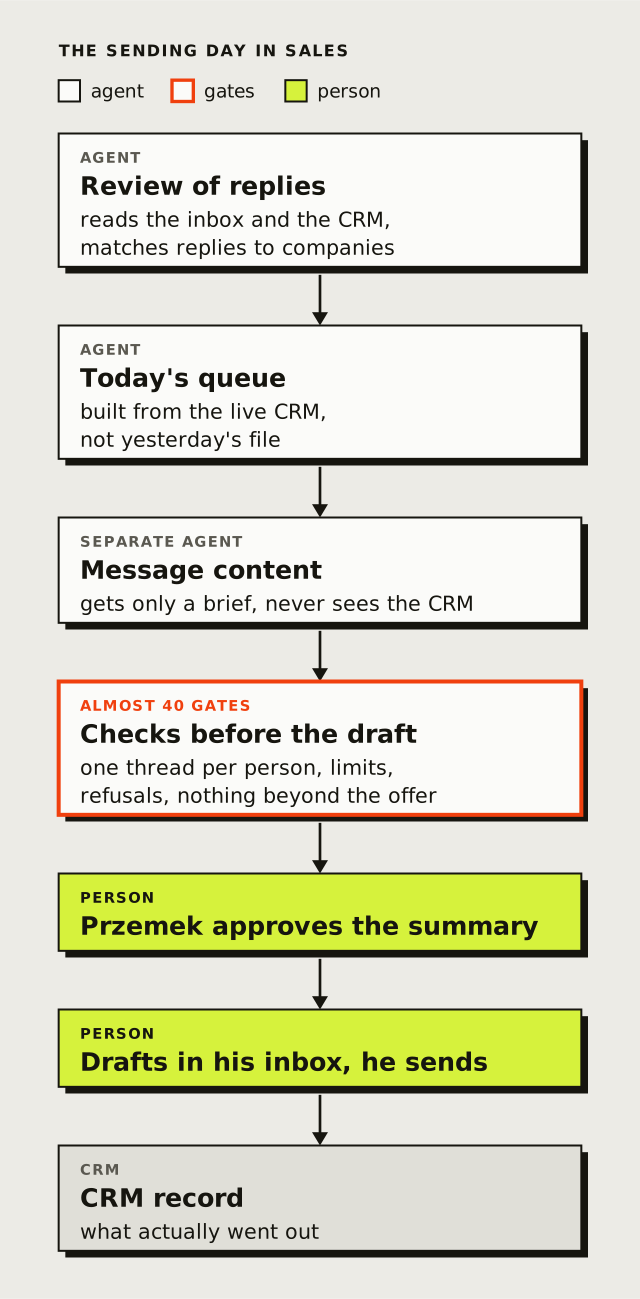
Almost 40 gates stand between a proposal and a draft. They make sure, for example, that each person has only one active thread, that the daily email limit and the limit of three touches per person are not exceeded, that nobody who said no gets another message, and that a message never promises anything outside what we offer.
Meeting prep takes us about an hour. The agent gathers information about the company and the person, the problem, a possible use case and the risks. We read it, sometimes ask follow-up questions and prepare materials. Some materials are ready earlier, but if something occurs to us at the last minute, the agent prepares it on the spot. We describe how this process looks in a rollout on the meeting preparation page.
After the call, the same content agent writes the email after a discovery call or a demo, from a brief built out of what was agreed.
Not everything worked from day one. Message quality at the start was not good enough, and most of our corrections went into the writing. Every correction that came up more than once became a doctrine rule or a gate, and we keep developing the system. What an agent in sales does and what stays with a person is collected in AI agents in sales.
Publishing: three loops and two gates
Content about Qamera AI for the blog, the company LinkedIn page and Przemek's personal profile comes out of one process. It consists of three loops that run separately, because their rhythms are completely different:
- Listening scans a few dozen sources, roughly once a week and in bulk, and proposes topics.
- Production writes one piece: the text, a carousel, a quality review and a risk classification.
- Publishing assembles the approved piece as a draft in the post scheduling tool.
Between the loops there are two gates where a person decides. At the direction gate we choose which topics are worth writing at all. At the quality gate we read the finished piece on a preview page where it can be edited right away, and approve the edited version. Approval from either of the two of us is enough. The exception is Przemek's personal profile: content under his name is approved and published only by him.
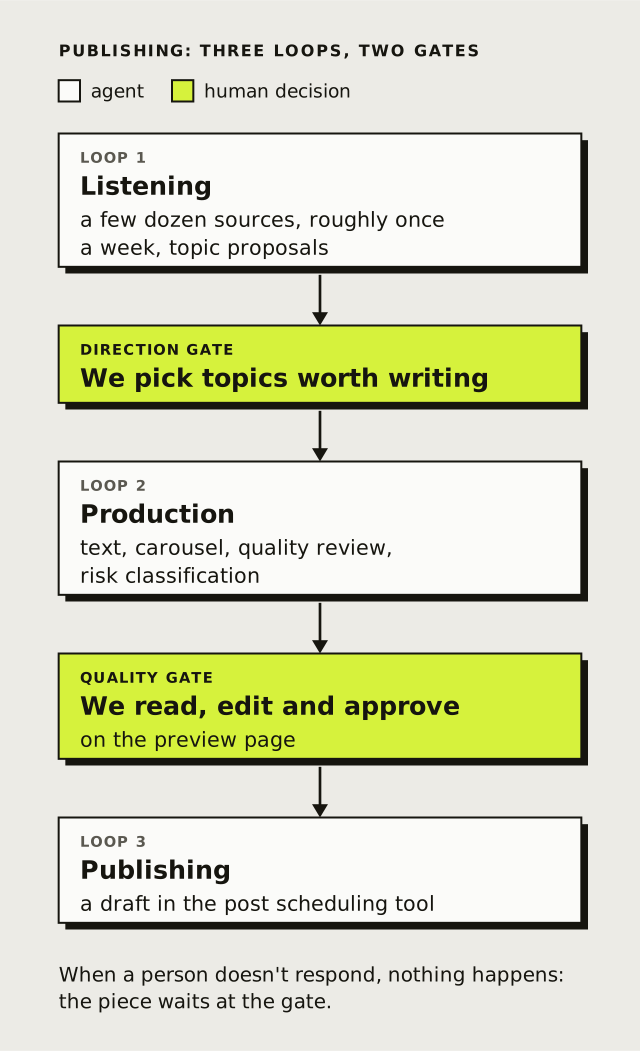
The most important rule: when a person doesn't respond, nothing happens. The piece waits. An earlier attempt at such a process collected more than 300 topics in fourteen months and shipped three posts, because between "we have something to write about" and "the post is out" there was no point where someone had to approve anything.
What the first full run showed
The first topic went through the whole process on 26 August 2026, and we measured every stage:
| Stage | Time |
|---|---|
| Listening: 9 sources, 204 items, 5 proposals | 4 min 29 s |
| Producing the first version | 26 s |
| Corrections after human feedback (three rounds) | about 50 min |
| From start to finished draft, including waiting at the gates | about 2 h 10 min |
The machinery cost minutes; the content cost hours. The feedback was about things no test would catch: our branding missing from the carousel, too many pauses in the text and no link between the topic and the product. Each of them became a rule that a script or the topic header has checked ever since, so the next piece doesn't start from zero.
Finance: the monthly close
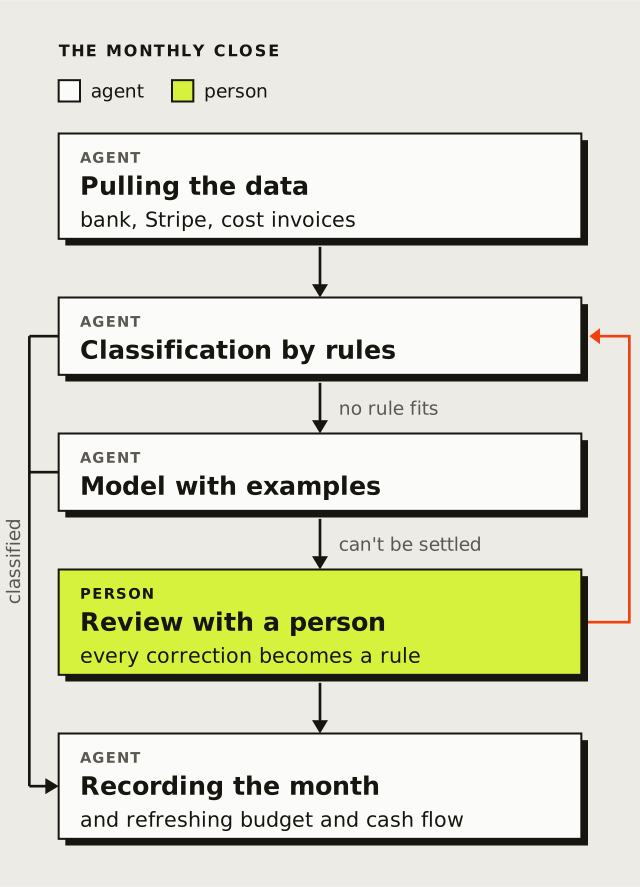
Paweł built the monthly close on the same system. The agent pulls bank transactions, Stripe revenue and cost invoices from the invoicing system, then classifies them: rules first, and a model with examples only when no rule fits. Whatever can't be settled goes to a review with a person. Every human correction becomes a new rule, so classification gets more predictable every month. Finally the system records the month and refreshes the budget and cash-flow summary. We have closed eight months this way, from February to September 2026.
How it is organized
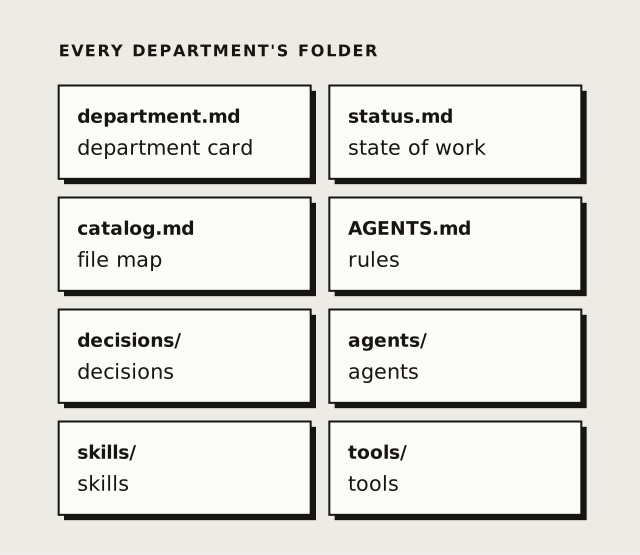
The whole company is one repository of files. Each department has its own folder with the same elements: a department card (department.md), state (status.md), a file map (catalog.md), rules (AGENTS.md), decisions (decisions/), agents (agents/), skills (skills/) and tools (tools/). The sales department has three agents and 29 skills, from finding companies to recording a client who has paid. Marketing, product and the agentic systems department follow the same layout, so an agent that knows one department finds its way around any of them.
What we learned on our own system
- Silence has to be visible. A piece approved on 3 August still hadn't gone out by 27 August, even though nothing was blocking it. Since then the report opens with the number of days the oldest item waiting on a person has been waiting.
- State goes stale. In a project's state file, a row about a blocker stayed for weeks after the issue was resolved, and agents treated it as current. Today every state row has a date and an owner, and reviewing it is a standing task.
- The gate has to be where the person works. Approval through a pull request worked for one of the two of us. For the other, GitHub is not a work tool, so we moved approval to the preview page.
- We measure after the fact. We check a publication's effect seven days after it goes out. We don't predict engagement, because with a few pieces a month no model can tell signal from chance.
We describe how the knowledge base all of this runs on is organized in a company knowledge base for AI agents. What an agentic system is in the first place, we explain in what is an agentic system.
What this means for you
This is the same system we roll out in companies: a knowledge base in files, agents assigned to processes, rules built from corrections and a person at every step that can't be undone. The difference is that we made the mistakes on our own system first, so a rollout doesn't start from zero. We describe what a rollout looks like and what it costs on the agentic system page.
Want to see what this would look like in your company? Book a meeting at a time that suits you. It takes about an hour and ends with choosing the first process. Prefer to write first? hello@200iqlabs.io.